
Welcome to this week’s publication of the Market’s Compass Developed Markets Country (DMC) ETF Study #593. It highlights the technical changes of the 21 DM Country ETFs that I track on a weekly basis and publish every third week. There are three ETF Studies that include the Market’s Compass US Index and Sector (USIS) ETF Study, the Developed Markets Country (DMC) ETF Study and the Emerging Markets Country (EMC) ETF Study. The three Studies are normally published every three weeks and are sent to my paid Substack subscriber’s email. A total of 71 ETFs are covered in the three Studies. There is also a Weekly publication that is sent to paid subscribers every Sunday titled The Market’s Compass Crypto Sweet Sixteen Study that tracks the technical condition of sixteen of the larger cap Cryptocurrencies.
To understand the methodology used in constructing the objective DM Country ETF Individual Technical Rankings visit the mc’s technical indicators page at www.themarketscompass.com and select “dm country etfs”. What follows is a Cliff Notes version* of the full explanation…
*The technical ranking system is a quantitative approach that utilizes multiple technical considerations that include but are not limited to trend, momentum, measurements of accumulation/distribution and relative strength of each individual DM Country ETF that can range between 0 and 50.
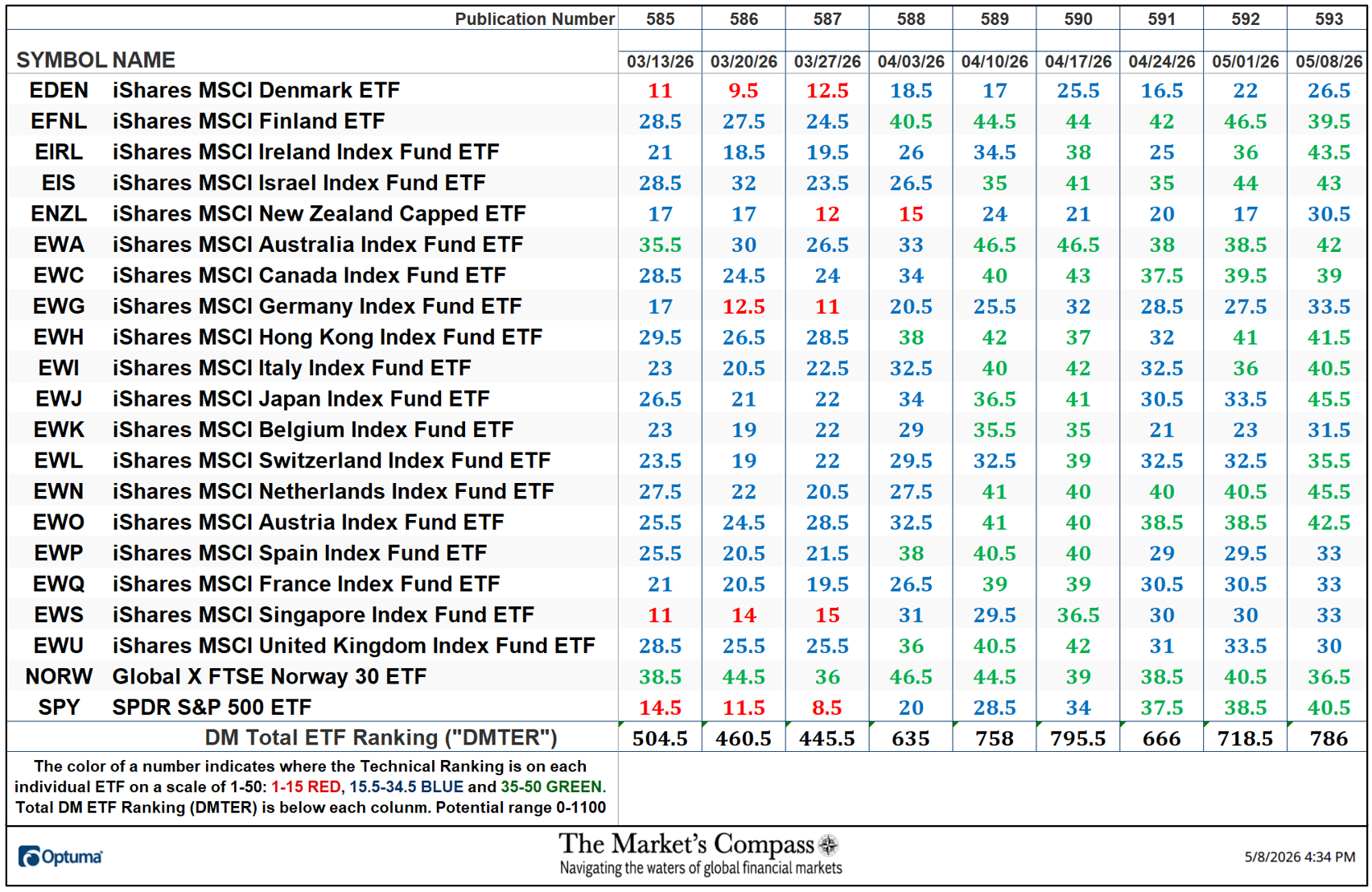
The Total DM Technical Ranking rose last week with a 9.39% rise to 786 from the week before reading of 718.5 which was a 7.88% jump from 666 three weeks ago.
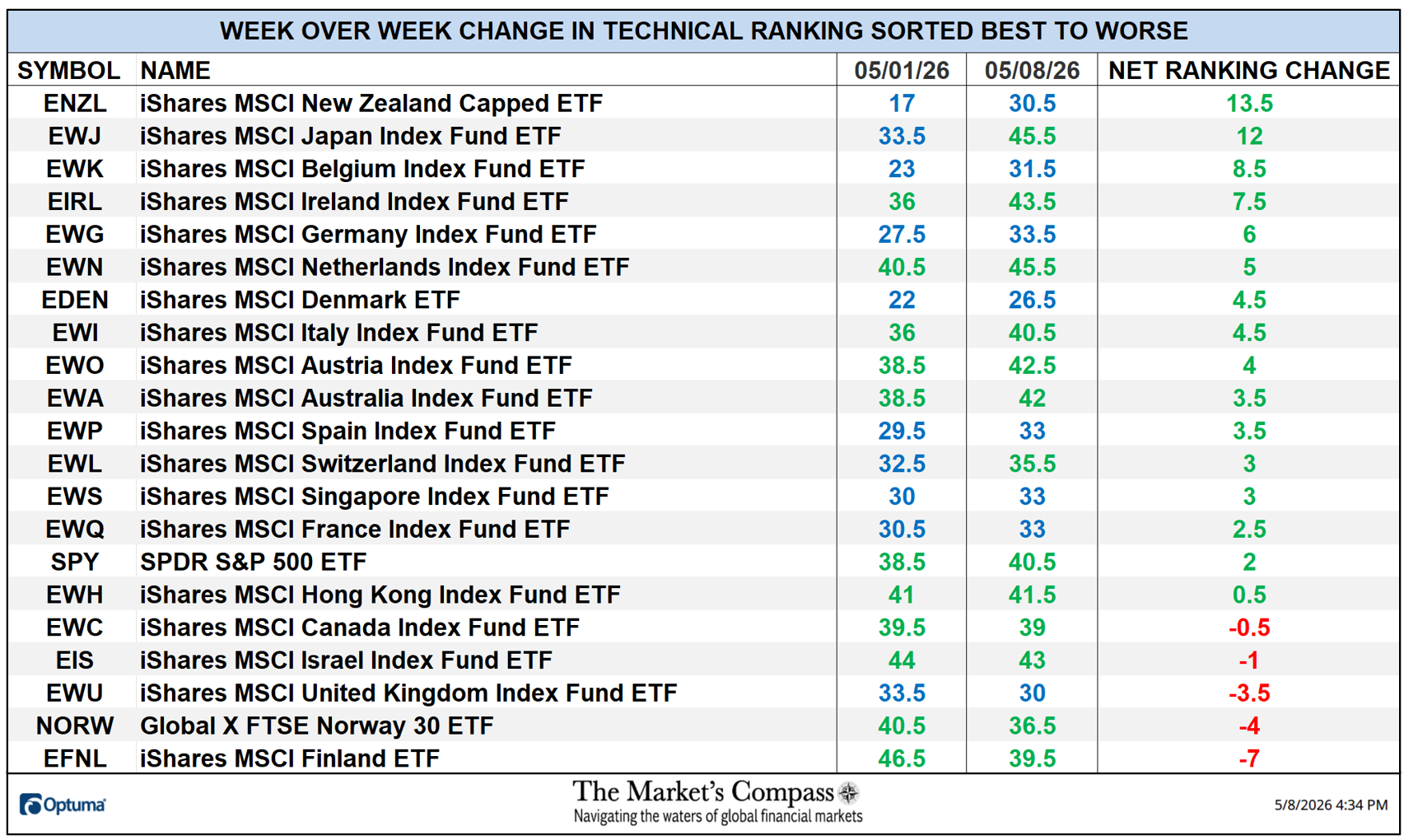
As of Friday’s close, sixteen DM ETF TRs gained ground on a weekly basis and five fell. Thirteen ended the week in the “green zone” (TRs between 35 and 50) and eight ending the week in the “blue zone” (from 15.5 to 34.5) For the fifth week in a row there were no TRs in the “red zone” (from 0 to 15). Two weeks ago, there were eleven ETF TRs in the “green zone” and there were ten TRs in the “blue zone”. The average TR gain for the week was +3.21 vs. the previous week’s average TR gain of +2.5.
The Relative Rotation Graph, commonly referred to as RRGs were developed in 2004-2005 by Julius de Kempenaer. These charts are a unique visualization tool for relative strength analysis. Chartists can use RRGs to analyze the relative strength trends of several securities against a common benchmark, (in this case the URTH) and against each other over any given time period (in the case below, daily) over the past three weeks. The power of RRG is its ability to plot relative performance on one graph and show true rotation. All RRGs charts use four quadrants to define the four phases of a relative trend. The Optuma RRG charts uses, from Leading (in green) to Weakening (in yellow) to Lagging (in pink) to Improving (in blue) and back to Leading (in green). True rotations can be seen as securities move from one quadrant to the other over time. This is only a brief explanation of how to interpret RRG charts. To learn more, see the post scripts and links at the end of this Blog.
Not all 21 ETFs are plotted in this RRG Chart. I have done this for clarity purposes. Those which I believe are of higher technical interest remain.
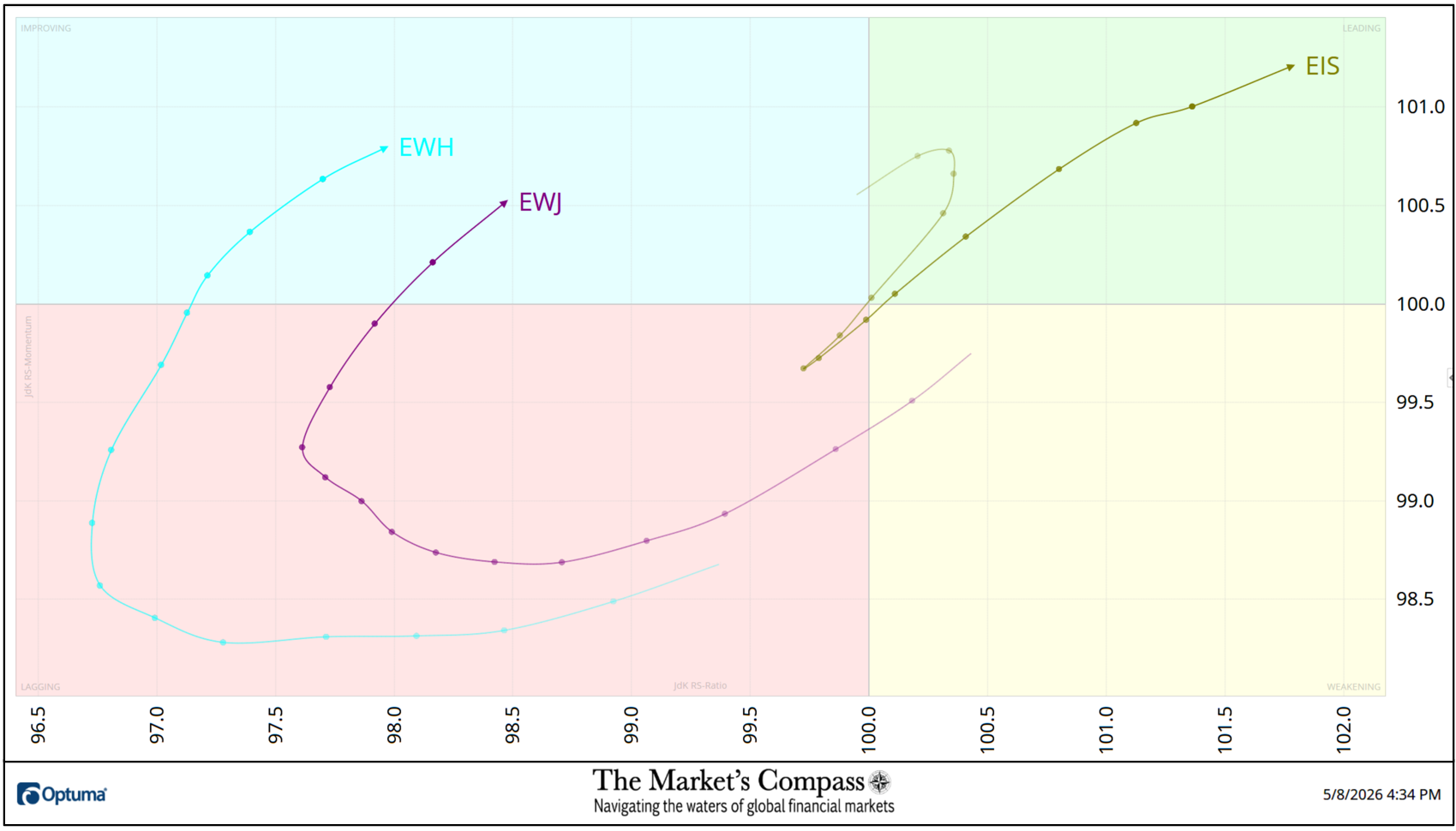
Two weeks ago the iShares MSCI Israel ETF (EIS) fell directly into the Lagging Quadrant from the Leading Quadrant but a sharp turnaround developed and last week the EIS accelerated back into the Leading Quadrant exhibiting a complete flip in Relative Strength Momentum, The EIS ended last week with the best Relative Strength Ratio vs. the iShares MSCI World ETF or URTH of the 21 DM ETFs (see the Tabulation Table below). The iShares MSCI Japan Index Fund ETF (EWJ) has made a three Quadrant move over the past three weeks. After falling from the Weakening Quadrant into the Lagging Quadrant it turned last week and entered the Improving Quadrant. The iShares MSCI Hong Kong Index Fund ETF (EWH) turned higher in the Lagging Quadrant two weeks ago and built a head a stream and rose into the Improving Quadrant during the second half of last week.
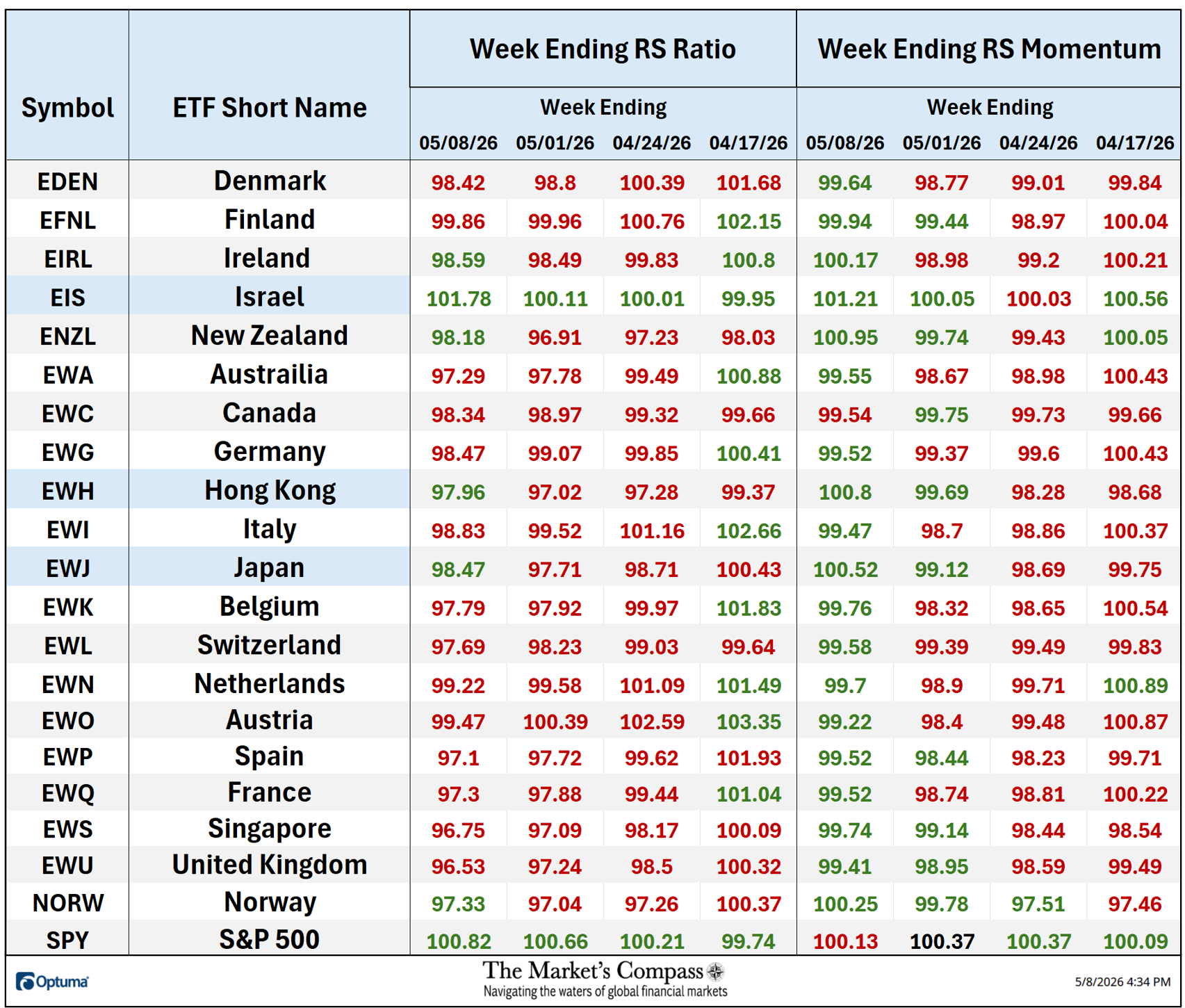
The Relative Strength and Relative Strength “Tabulation Table” begins with the readings at the end of last week followed by the trailing three weeks that includes the Readings from the last Study. If there has been an improvement in either the Relative Strength Ratio or the Relative Strength Momentum reading on a week-over-week basis I have highlighted it in green. If there has been a contraction in either, it is highlighted in red and an unchanged reading in either will remain in black. The color-coding system serves as a heat map over the past four Friday’s readings highlighting either the continued improvement, deterioration, or stasis vs. the benchmark, the URTH. The ETFs that are displayed on the RRG chart above have the Symbol and ETF Short Name highlighted in blue below.
*To understand the construction the of The Technical Condition Factors or TCFs visit the mc’s technical indicators page at www.themarketscompass.com and select “dm country etfs”. For those who unfamililar a shortened version* is explained below…
*The Technical Condition Factors are utilized in the calculation of the Individual DM Country ETF Technical Rankings. What is shown in the excel panel below is the total TCFs of all twenty-one TRs. A few TCFs carry more weight than the others, such as the Weekly Trend Factor and the Weekly Momentum Factor in compiling each individual TR of each of the twenty-one ETFs. Also, the TCFs number of inputs vary. Because of that, the excel sheet below calculates each factor’s weekly reading as a percentage of the possible total which normalizes the inputs. The basic explanation is that the eight TCFs can range between 0% and 100%.
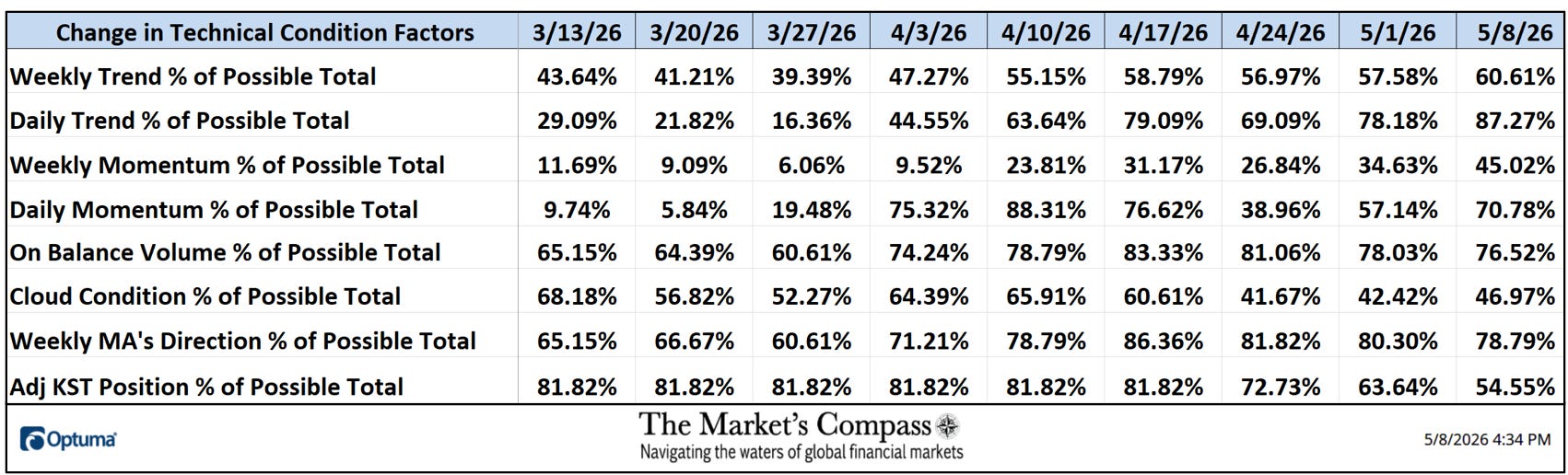
The Daily Momentum Technical Condition Factor (“DMTCF”) rose to 70.78 or 109 last week from 57.14% or 88 the previous week,
As a confirmation tool, if all eight TCFs improve on a week over week basis, more of the 21 ETFs are improving internally on a technical basis, confirming a broader market move higher (think of an advance/decline calculation). Conversely, if more of the 21 TCFs fall on a week over week basis, more of the ETFs are deteriorating on a technical basis confirming the broader market move lower. On a week-over-week basis five TCFs rose, and three fell.
An explanation of The Total DM Technical Ranking Indicator and the technical interpretation of it, visit the MC’s Technical Indicators page at www.themarketscompass.com.
It is simply a confirmation/divergence indicator as well as an overbought/oversold indicator.
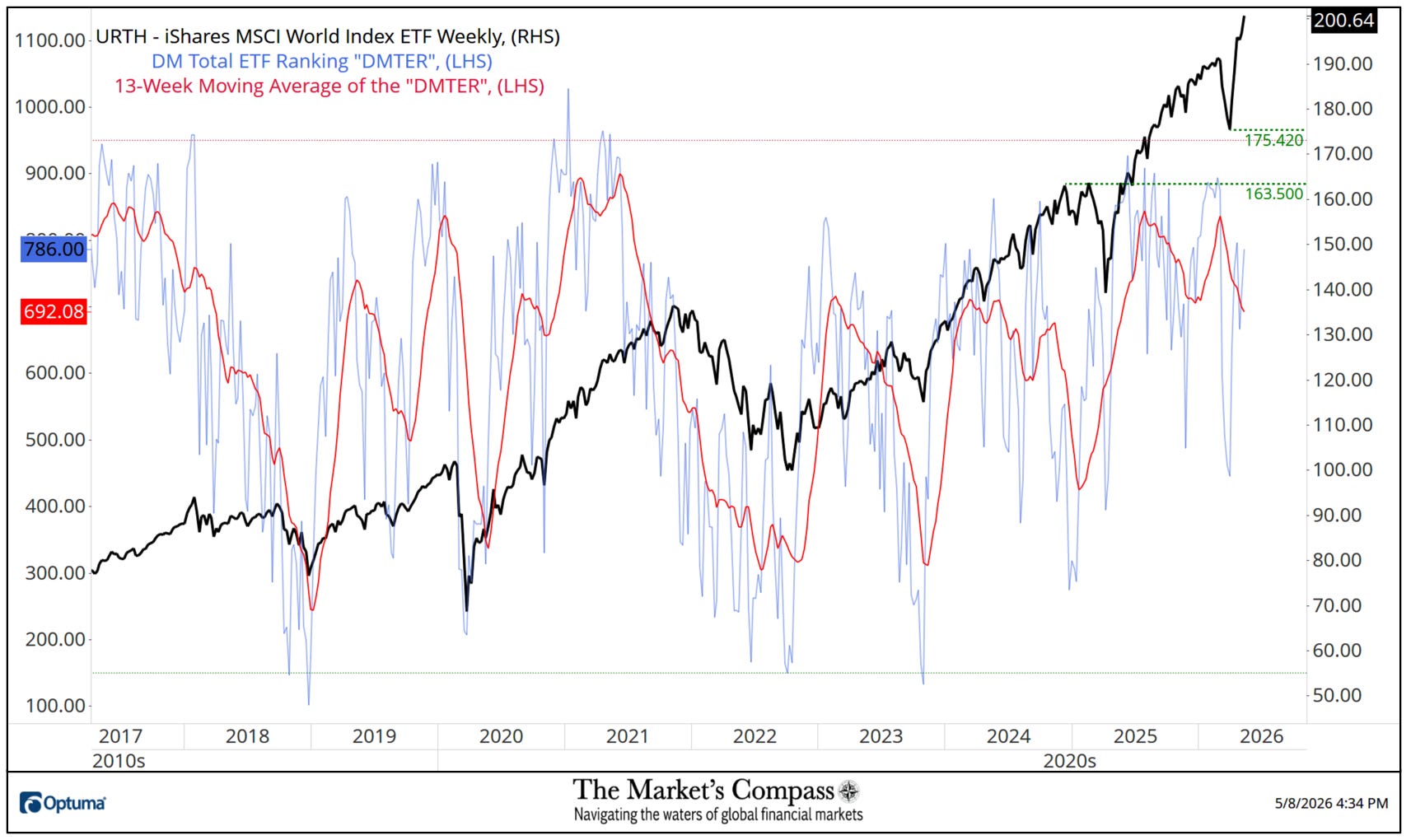
The iShares MSCI World Index Fund ETF rose to another weekly closing high of 200.64. The DM Total ETF Ranking or DMTER for the third week in a row to 786 but has not come close to confirming the new weekly closing highs. In addition, the 13-Week Moving Average (red line) of the DMTER has continued to fall and has notched a lower low.
The Weekly Average DM Technical Ranking (“ATR”) in the bottom panel, is the average of the individual Technical Rankings of the 21 Developed Markets Country ETFs I track. Like the TER, it is a confirmation/divergence or overbought/oversold indicator.
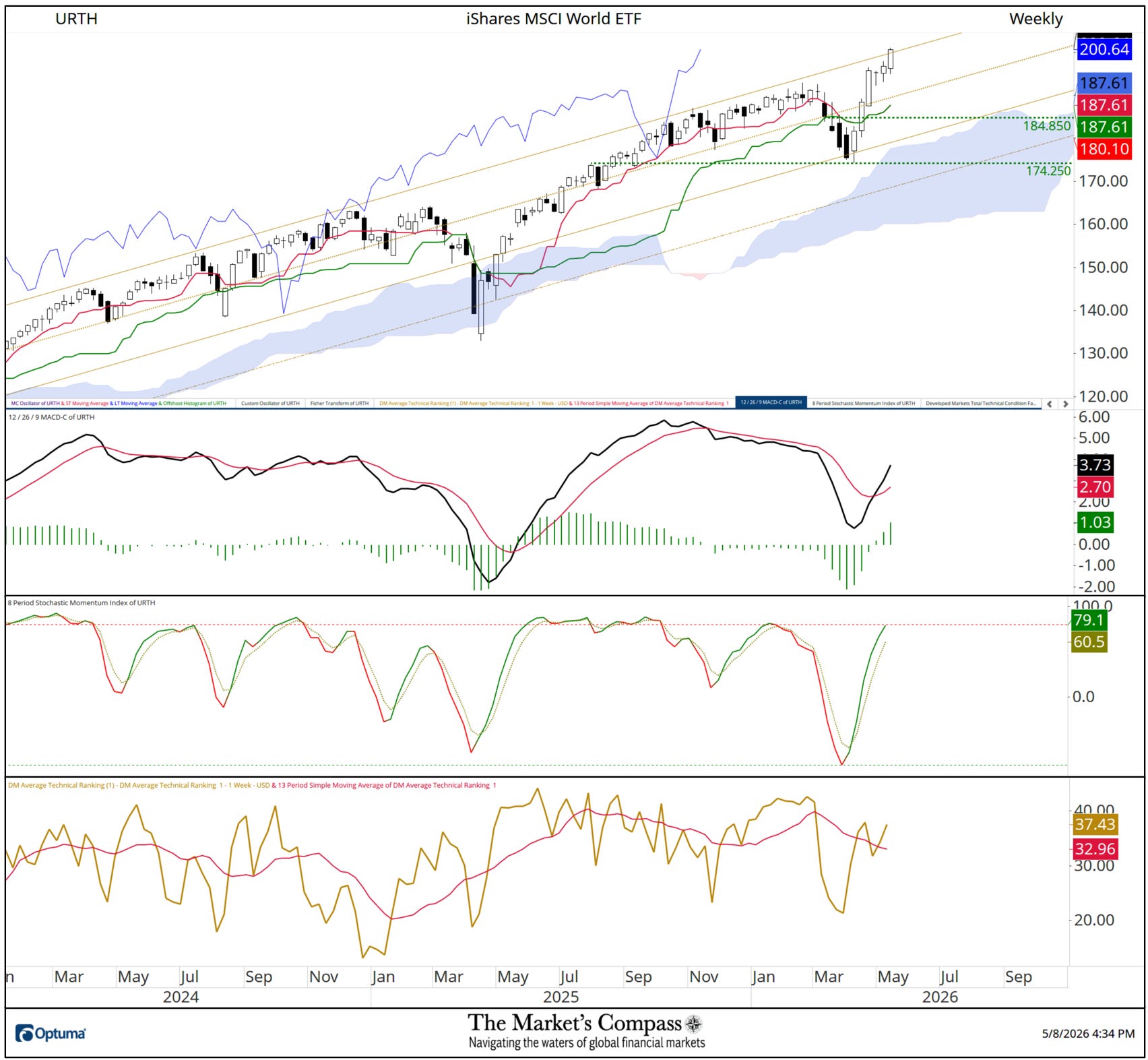
It has been hard to argue with the impulsive and constructive price advance over the past six weeks. After two weeks of consolidation the URTH has moved to new highs. In doing so it closed last week just above the Upper Parallel (solid gold line) of the Standard Pitchfork that found its origin in March of 2023 and has contained prices since then notwithstanding the drop below the Lower Parallel in April of last year. MACD reflects the upside price momentum from the early April lows, but the 8-Week Stochastic Momentum Index (center oscillator panel) is approaching over-bought territory but as can be seen by looking back to the third quarter of last year while prices grind higher. Aside from a brief pullback, two weeks ago the Average Technical Ranking or ATR confirmed the rally from the early April lows but the 13-Week Moving Average of the ATR (red line) has yet to turn higher.
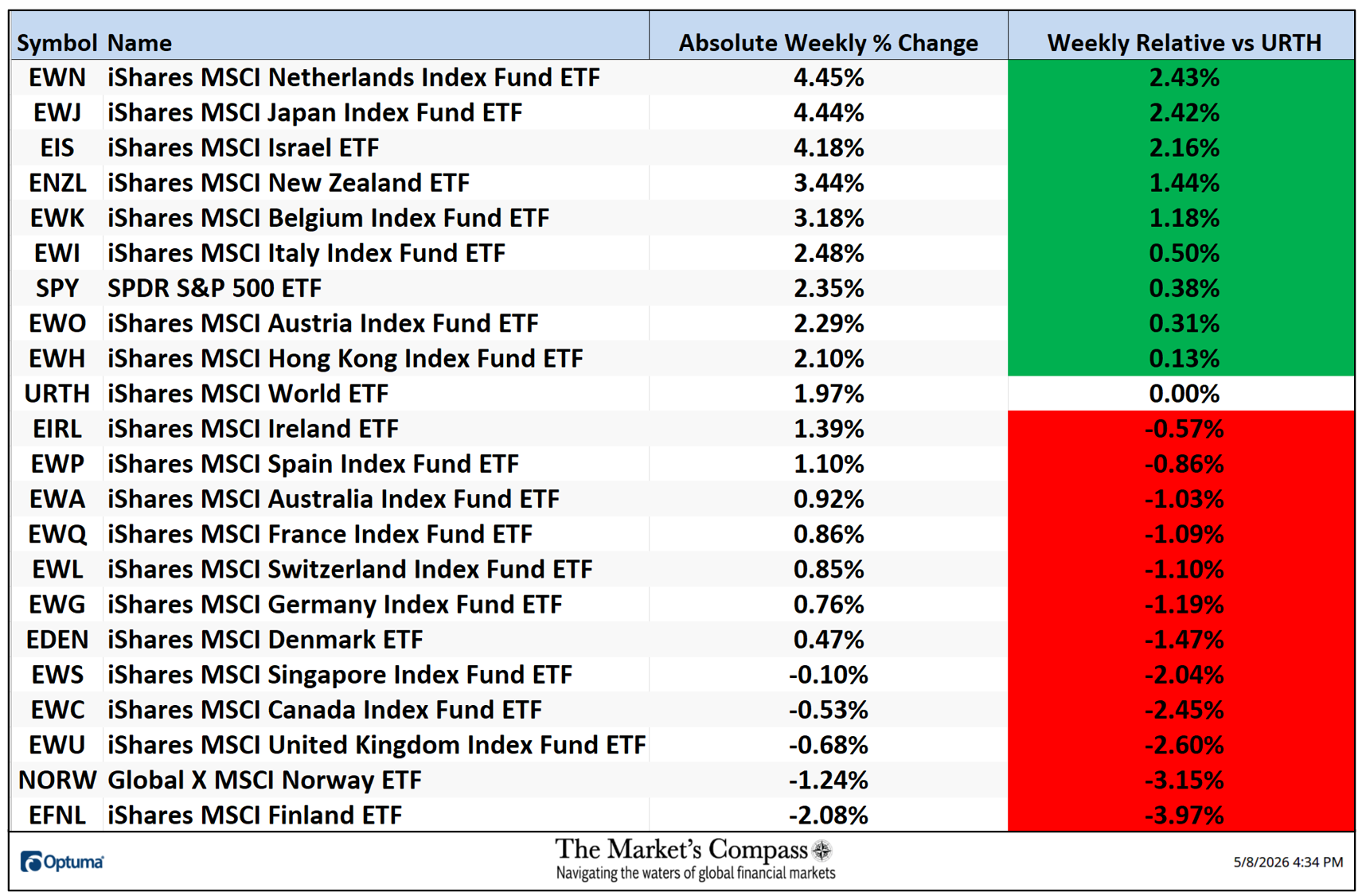
*From Friday May 1st to Friday May 8th
Sixteen of the Developed Markets Country ETFs I track in these pages were up on an absolute basis and five were down over the past week. Nine of the DM ETFs outpaced the +1.97% gain in the iShares MSCI World ETF or URTH last week and twelve underperformed, that was vs. the week before when twelve outperformed and nine underperformed the +0.76% gain in the URTH. The five-day average absolute price change was +1.76%, adding to the previous week’s average price gain of +1.07%.
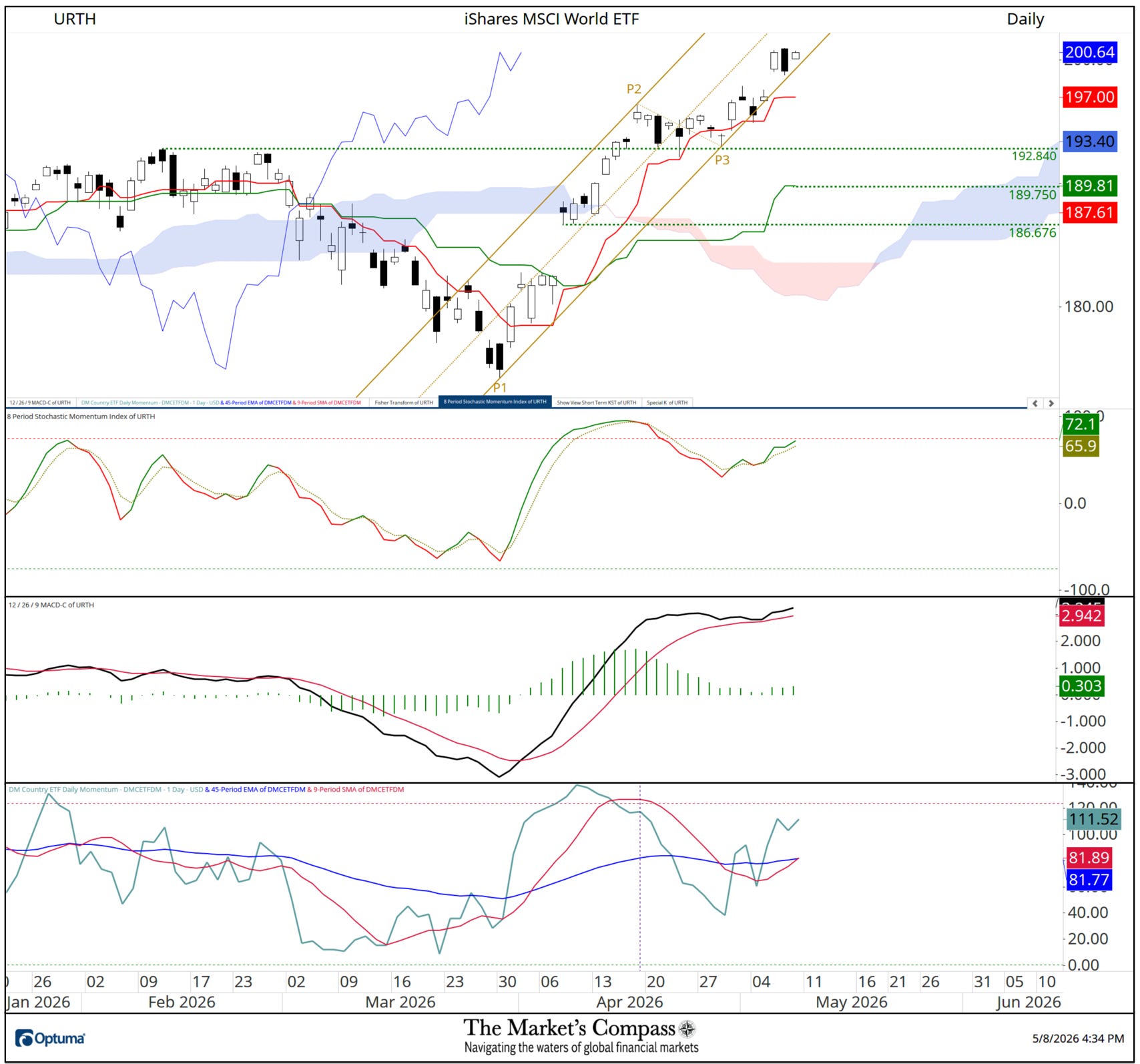
After a week ago last Thursday’s rally to a new closing high that suggested that the short-term price consolidation had reached its terminus, I added a new Schiff Modified Pitchfork (gold P1 through P3). Aside from a minor violation last Monday, prices held support at the Lower Parallel (lower solid gold line). The price consolidation worked off a measure of the short-term overbought condition reflected by the pullback in the Stochastic Momentum Index. I find it technically positive when that happens and there is very little price damage. MACD avoided a drop below its signal and is edging higher again. The DM Country ETF Daily Momentum / Breadth Oscillator printed a lower high (black dashed vertical line) at the P2 price pivot high giving fair warning of the price pullback / consolidation and has turned higher again since the P3 price pivot low with the 9-Day Moving Average (red line) set to retake the ground back above the 45-Day Exponential Moving Average (blue line).
Only a break of Lower Parallel support would suggest that a correction of a larger degree could unfold with a test of key support at the 192.84 level possible.