
Gimbal cameras, or ‘pocket gimbal cameras’ are one of the weirdest designs in the action camera/vlogging market. Essentially, they are a small camera unit mounted on a gimbal on top of a handle which contains the screen, the battery, controls and electronics. If you’ve ever looked at a mirrorless camera gimbal and thought it’s just too big and awkward for you, then a gimbal camera could be just what you need.
As a drone expert I described a pocket gimbal cameras as being like a drone’s gimbal camera mounted on a handheld grip – admittedly more useful if you’re used to better quality video-capable drones.
So can a gimbal camera match the image quality of the best hybrid cameras, or the best cameras for vlogging? Not quite, though the DJI Osmo Pocket 3 comes close with a 1-inch sensor the same size as many popular compact vlogging cameras like the Sony ZV-1, or Canon’s ever-popular PowerShot G7 X III.
Latest Videos FromDigital Camera World
And the newer (but harder to get hold of) DJI Osmo Pocket 4P or Insta360 Luna Ultra offering dual cameras will certainly take on the flexibility of multiple-lens phone camera systems on the best smartphones.
Ultimately it also depends on what you mean by ‘quality’. A gimbal camera can give you much smoother camera movements and a much more professional look than you can achieve using a regular camera handheld. The perceived quality for viewers can actually be higher.
If you regularly film with one ofthe best action cameras and find the quality perfectly good for your needs, then these gimbal cameras can provide the same quality or more, and they film in a way that regular cameras can’t because they smooth out camera movements in a way that only a motorized gimbal can.
But which is the best gimbal camera to get? It depends on your budget, your expectations and the features you most need. So let’s take a look at four key rivals.
Best pocket gimbal cameras
Why you can trust Digital Camera World
Our expert reviewers spend hours testing and comparing products and services so you can choose the best for you. Find out how we test.
Best gimbal camera overall
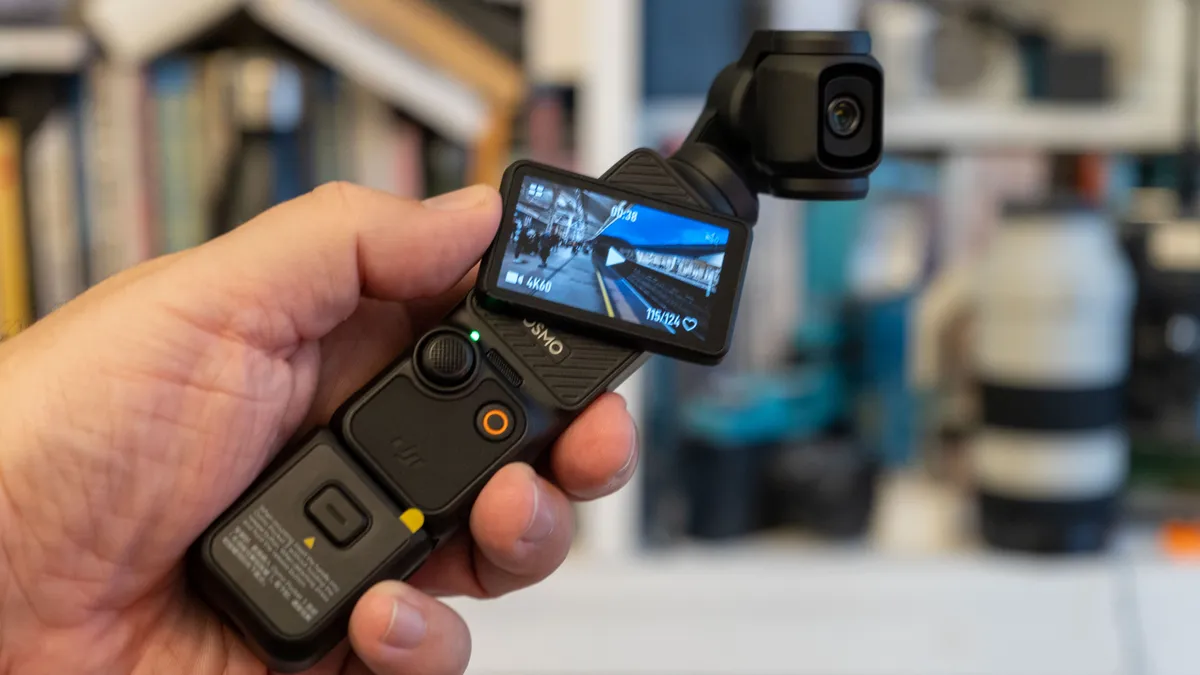
Right now, the new DJI Osmo Pocket 4 is getting all the attention in the gimbal cameras market, and while in tech terms the Osmo Pocket 3 might be seen as a close second it has some significant benefits too, which is where it’s here in our guide.
For one thing one of the main Pocket 4 upgrades is built-in storage and buying a separate memory card is unnecessary for many. Some even insist on using the removable cards even with the 4 series.
The Pocket 4 also has a sibling – a dual camera system called the Osmo Pocket 4P which is very nice indeed if you can get it, but expect it to adjust your budget!
In any case the DJI Pocket 3 has an excellent sensor which rivals some of the best compact vlogging cameras. It also has excellent subject tracking and unrivaled 4K video frame rates, right up to 120fps.
It’s a camera that is genuinely worth taking seriously as a professional filmmaking tool, and DJI’s ecosystem of accessories makes it even more powerful and adaptable. All this comes at a price, though, especially if you opt for the Creator Combo. This kit gives you everything you need for serious filmmaking, but pushes the price way up compared to its rivals. And while this is a very powerful camera, it’s also one that can take a while to learn fully, because there’s a lot to explore and take in.
See our DJI OSMO Pocket 3 review
Best gimbal camera for power users

The Insta360 Luna Ultra arrived at more or less the same time as the DJI Osmo Pocket 4P, but carries a number of advantages (not least availability in the USA). These include 8K video (probably not that useful for most people) and a removable face ‘remote control’ that includes the screen.
This simple-to-detach device is so much easier to use than apps or fiddly Bluetooth accessories (I’m looking at you, DJI), and lets you take the class-leading tactile controls with you, up to 66ft / 20m from the camera. At that distance, the 60mm EFL lens – the longer of the two, the other being 20mm EFL – really shows its worth, as does the remote’s built-in mic.
The camera can shoot in Log and at an extensive range of resolutions, 8K30 being the headline grabber, but 4K at up to 120 is also available. Thanks to Insta360’s partnership with Leica, those who like to apply styles as they shoot get a cool range of film looks that are ready to go straight off the camera (possibly literally, as there is 47GB of on-board storage as well as a MicroSD slot).
The 1-inch sensor helps provide good video, even in low light, and the color and detail is impressive. The price is higher than the Pocket 4P, but the innovations – even simply the built-in fold-out tripod – make this potentially far more useful for a vlogger, especially a solo operator needing reliable subject tracking or remote control.
Read my full review of the Insta360 Luna Ultra
Most flexible gimbal camera

Best gimbal camera for beginners

A brilliant idea like the HoverAir Versa seems like it might come with some compromises, so when I tested it I was on the lookout for them all – bad connections, dubious hardware and – most of all – weakness. Somehow I imagined the wings coming off. I was genuinely surprised.
The concept of taking a single gimbal camera and letting you use it as a pocket device and as a “follow-me” style drone even has advantages I hadn’t anticipated, like the built in 55GB of memory will end up containing all your footage, reducing effort when it comes to transferring it to your phone for sharing.
The 4K video is surprisingly good for a relatively small sensor, and the Versa has stuck to a very simple control scheme which means that despite what would seem to add complexity – wings and the like – there are actually cameras on this list which are less natural to operate.
Read my full HoverAir Versa review
The Realimove MC3X is a fairly basic gimbal camera with a small sensor that starts to struggle somewhat in low light and limited high-speed filming capability. It can only manage 30fps when shooting 4K video and you have to drop to a lower resolution for 60fps or 120fps slow motion.
But it has its good sides too. For a start, its 3.5-inch rotating screen is far larger than the screens on rival gimbal cameras, even the mighty DJI Osmo Pocket 3. This makes it much easier to see what you’re filming and to navigate the menus and settings.
There is a companion app, but you can do pretty much everything using the camera’s built-in controls, so you probably won’t need it. The big screen and simple operation make this an ideal gimbal camera for beginners.
See our full Agfaphoto Realimove MC3X review
Best gimbal camera for flexible shooting styles

The Feiyu Pocket 3 has a unique party trick. The gimbal/camera unit can be separated from the handle, which can then be used as a remote control. The idea is that you can place the camera unit where you like (it even has a magnetic base) and in places where a regular gimbal camera wouldn’t fit. The Pocket 3 is fully wireless, so there are no cables to trip over or snag. This is where it’s different to the Feiyu Pocket 2s, where the camera is connected to the handle by wire.
On the downside, the Pocket 3 has a small 1/3.2-inch sensor, which inevitably means that the image quality suffers in poor light, and the screen is both small and non-rotating. There’s also no way to attach an external mic, so although the Feiyu Pocket 3’s detachable camera design is unique, the camera itself is pretty basic.
Check out our full Feiyu Pocket 3 review
Also consider: the older Feiyu Pocket 2S is similar to the Pocket 3, but its detachable camera has a wired connection rather than a wireless one.
Best gimbal camera for value

In principle, the DJI Pocket 3 replaces the previous Pocket 2, but for now at least the older model is still on sale and represents extremely good value. Its principal downfall is its tiny 1-inch screen, which makes its companion Mimo smartphone app pretty essential. On the other hand, it has a 1/1.7-inch sensor that’s significantly larger and better than the smaller sensors in the Agfaphoto and the Feiyu. It can also film at up to 4K 60p, has very good subject tracking (though the Osmo Pocket 3 is better still), and comes with a hard shell case which offers good protection without adding much to the bulk. In particular, the case protects the gimbal mechanism, which is always a vulnerable component in gimbal cameras, so you can put the Pocket 2 in your pocket without worrying about the gimbal. At current prices, the DJI Pocket 2 is a great buy.
See our full DJI Pocket 2 review
FAQ
How are gimbals different to stabilization?
Camera and lens stabilization can reduce the ‘jitters’ with handheld photography and video, but they have a limited range of movement so they can’t smooth out camera panning and tilting movements. This is where you need a gimbal, which can rotate and tilt the camera smoothly even if your own movements are quite fast.
Why do the best gimbal cameras have rotating screens?
It’s because many creators will want to shoot vertical video for their social channels rather than regular horizontal video. Having a rotating screen makes switching the orientation quick and intuitive.
Are gimbal cameras good for vlogging?
They are perfect for the job because the whole camera can rotate to face you – you’re not using a secondary ‘front’ camera like you would on a smartphone. They are especially effective for walk-and-talk filming where you can turn the camera on yourself and then the scene in front of you.
What is object tracking and how does it work?
This is one of the key advantages of a gimbal – it can turn to follow a subject around a scene while you’re filming, and you don’t have to move or turn to do it. You can also film yourself presenting to the camera while walking around and the camera will follow you.
How to choose
Here are some things to look for in a gimbal camera:
• Screen size: A small screen like the one on the older DJI Pocket 2 is hard to see and makes menu navigation fiddly. A big screen like the one on the Agfaphoto Realimove MC3X is a major advantage.
• Sensor size: A small sensor will be fine in good light, but will lose detail and show more noise in darker conditions. The DJI Pocket 3 has a larger 1-inch sensor which gives much better quality in low light.
• Accessories: Can you attach an external microphone for better audio? Can you get wide-angle or other lens adapters? Can you get filters? You may not need any of these things, but if you do, check what the maker offers. DJI leads the field for custom accessories.
How we test
Gimbal cameras are a unique kind of filmmaking tool, so as well as checking the video quality as we would with any video camera, we also test these cameras for smoothness of operation (they’re all good, in fact) and stabilization. Is the subject/face tracking effective? How do they perform at night or indoors in low light? How easy is it to use the onboard controls?
We also test these cameras for practicality. DJI and Feiyu use ‘Pocket’ in the name, but can you or would you really put these cameras in your pocket? Does the gimbal head feel exposed or is it ‘parked’ neatly out of harm’s way when the camera is powered down? How quickly and easily do these cameras start up and how easy is it to change the orientation and filming settings?
With gimbal cameras like these, the image quality is obviously important, but so is the everyday handling and usability.