
- Fed Governor Waller claims the hype phase of crypto is ending, paving the way for serious integration with traditional financial systems and payment rails.
- The transition to institutional adoption requires solving the ‘harvest now, decrypt later’ threat posed by future quantum computing capabilities.
- BMIC is capitalizing on this shift by providing a quantum-secure wallet and finance stack, attracting over $445K in early presale capital.
- The market is rotating away from speculative assets toward infrastructure plays that offer long-term security and AI-enhanced utility.
Fed Governor Christopher Waller just delivered a cold splash of reality to the digital asset market when speaking at the Global Interdependence Center. His take? The speculative hype defining earlier crypto cycles is fading.
But unlike the bearish sentiment of 2022, Waller frames this cooling not as a death knell, but as a graduation. His comments regarding ‘skinny master accounts,’ granting non-banks direct access to Fed payment rails, suggest the marriage between traditional finance (TradFi) and blockchain is moving from theoretical pilots to actual regulatory plumbing.
Why does this shift in rhetoric matter? Because it redefines value for the current cycle. If the Fed is preparing for a world where stablecoins interact directly with central bank-ledgers, the ‘Wild West’ era is officially dead.
Institutional integration demands rigorous standards, turning the spotlight away from fleeting meme coins and toward infrastructure that can survive regulatory scrutiny. The market sees the writing on the wall: capital is moving from high-risk speculative assets into utility-driven protocols designed to secure this new hybrid financial system.
With the hype settling, the focus intensifies on the technical vulnerabilities of this burgeoning system. The most pressing? Security. Specifically, the ‘harvest now, decrypt later’ attacks threatening to undermine the very encryption securing Bitcoin and Ethereum.
Investors are increasingly pivoting toward BMIC ($BMIC), a project building the quantum-secure infrastructure necessary to support the Fed’s vision of a secure, integrated digital economy.
Securing The TradFi Bridge Against ‘Harvest Now, Decrypt Later’ Threats
Governor Waller’s comments highlight a critical intersection: as TradFi merges with DeFi, the attack surface expands exponentially. Banks and payment processors can’t afford the security vulnerabilities retail users have historically tolerated.
Current cryptographic standards, Elliptic Curve Cryptography (ECC), are sitting ducks for the looming threat of quantum computing. This is where BMIC ($BMIC) positions itself, not merely as a wallet or token, but as a necessary shield for the digital future.
BMIC addresses the ‘harvest now, decrypt later’ vector, where bad actors steal encrypted data today to unlock it once quantum computers become viable. The platform offers a Full Quantum-Secure Finance Stack, ensuring that transactions settled on-chain today remain secure a decade from now.
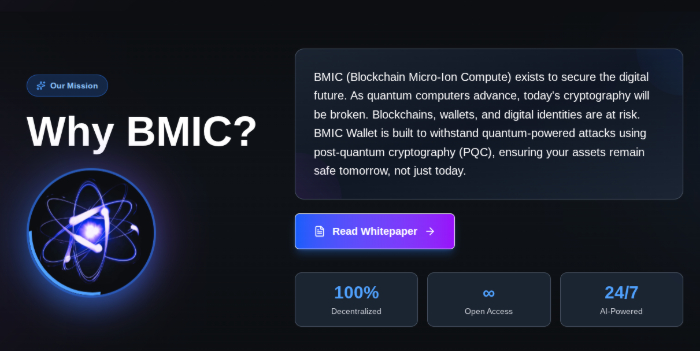
Unlike legacy wallets that leave public keys vulnerable during transactions, BMIC utilizes Zero Public-Key Exposure technology. This prevents the most common vector for future quantum attacks, aligning perfectly with the institutional-grade security a Fed-integrated crypto market would require.
Plus, the integration of AI-Enhanced Threat Detection allows the protocol to identify malicious patterns in real-time. For enterprises looking to interact with the ‘skinny master accounts’ Waller alluded to, this level of security isn’t a luxury; it’s a compliance necessity. The pivot toward this utility is evident, as investors recognize that without quantum-proofing, the integration of trillions of dollars into blockchain rails is a castle built on sand.
EXPLORE THE BMIC SECURITY STACK
Smart Money Rotates Into BMIC As Quantum-Resistant Infrastructure
While the broader market digests the implications of the Fed’s stance on payment rails, forward-looking capital is already positioning itself in the $BMIC presale. The project has raised $445K to date, a figure that underscores the growing demand for defensive infrastructure in a maturing market. Currently priced at $0.049474, the token represents an entry point into a sector, quantum security, that is arguably undervalued relative to the existential risk it mitigates.
The project’s utility extends beyond simple storage. The ‘Quantum Meta-Cloud’ creates a decentralized, encrypted environment for data and value transfer, solving the legacy wallet risks that plague current Ethereum users. By utilizing ERC-4337 Smart Accounts, BMIC improves the user experience without sacrificing the post-quantum cryptography that defines its value proposition.
This dual focus on usability and extreme security makes it a prime candidate for the type of ‘utility’ investors Waller suggests will survive the fading hype cycle.
The tokenomics fuel this ecosystem, with use cases spanning governance, staking, and ‘burn-to-compute’ mechanics. As the narrative shifts from ‘number go up’ to ‘system stability,’ projects that offer genuine technological moats are outperforming purely speculative assets.
The data points to a clear trend: the hype is indeed fading, replaced by a race for survival-grade tech.
BUY YOUR $BMIC ON ITS OFFICIAL PRESALE PAGE
This article is not financial advice. Cryptocurrency investments carry high risks, including total loss of capital. Always conduct independent research before investing.