
Five decades on from “Year Zero” – when the Khmer Rouge commenced its despotic regime – Cambodia’s capital, Phnom Penh, has a sparkly new airport, designed by star architect firm Foster & Partners.
Opened in September, Techo International is proof of burgeoning confidence in the country’s appeal as a tourist destination. Prime Minister Hun Manet, at its opening, said the country was emerging from “the darkest chapters of history.”
For some visitors, though, there are more recent concerns. Last year, a border conflict with Thailand led to airstrikes, internal displacement and more than 100 deaths. In December, a ceasefire was agreed. While tensions remain, leaders in the country are optimistic that 2026 will usher in a new wave of tourists.
A new airport opened in Siem Reap in 2023, about an hour’s drive from the centre. As the gateway to the Angkor temple complex, Cambodia’s second city was in need of this; the vibrations and traffic of the old airport were potentially damaging to the ancient structures.
Read more: India’s women’s ice hockey team showed me why winter in Ladakh is so special
Last year, Unesco also listed major historic Cambodian locations as world heritage sites: the Killing Fields execution site and two Khmer Rouge prisons.
But it’s not just in transport hubs and Unesco recognition that Cambodia has started to come of age. Twenty years ago, just about the only sniff of luxury in Siem Reap was its five-star Raffles (“we all applied for jobs when it re-opened in 1997,” my guide, Kim, tells me). Today, I’m picked up by a uniformed driver in an air-conditioned car, which glides through rural landscapes, where long grasses are reflected in shallow pools of storm-season rainwater, to the FCC Angkor by Avani.
Designed around the erstwhile French governor’s residence, and formerly the Foreign Correspondents Club, the property was reopened under the Avani banner in 2019. Tropical foliage surrounds the sunbed-flanked pool on one side of the property; across the road, room patios lead immediately into the water. Elsewhere, an open air bar fronts a water feature. The spa serves up sigh-worthy massages and the restaurant hosts a roster of local entertainment as an accompaniment to exceptionally good food.
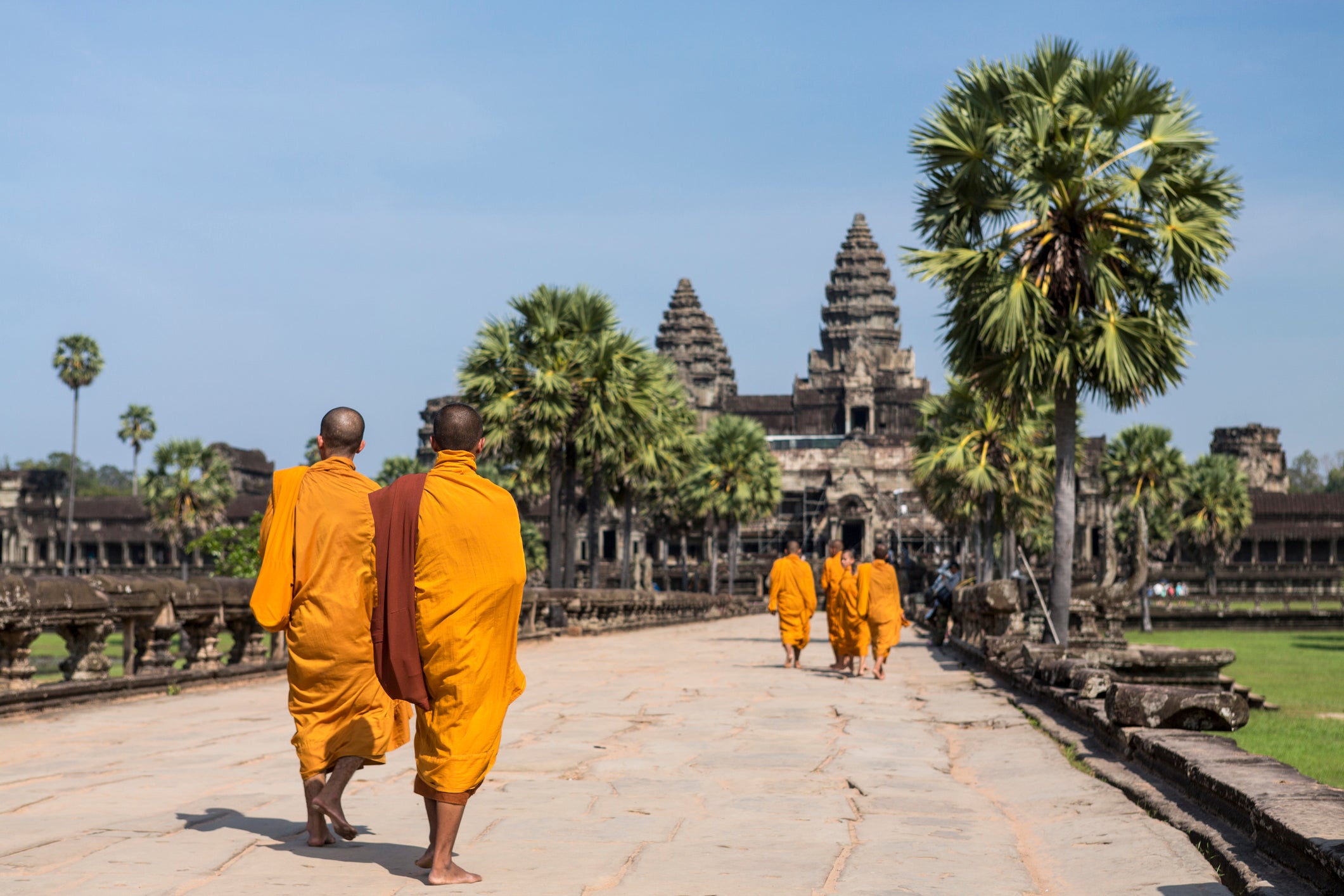
Such luxuries are undeniably pleasant to return to after a day of exploring in sticky heat: I’d timed my visit for the end of the wet season – or the “green season”, as the locals more cheerfully call – so grey skies, humidity and sudden, short-lived storms were the norm. It meant that I didn’t get the money shot of Angkor Wat, backlit by the rising sun, but I also wasn’t swimming against a tourist tide as I made my way around the 12th century complex, peering closely at bas-relief figures.
Kim, himself a craftsman, encouraged me to look into the corners, where stonemasons, sheltered from the stern eyes of foremen, could get a little more creative with their carvings, often showing figures holding hands, to denote their own friendship, or images of their mothers and sisters. Looters and time have stripped the colour from this and other temples, but Andrew Booth’s The Angkor Guidebook, thoughtfully provided by the hotel, contains detailed research-based artistic impressions.
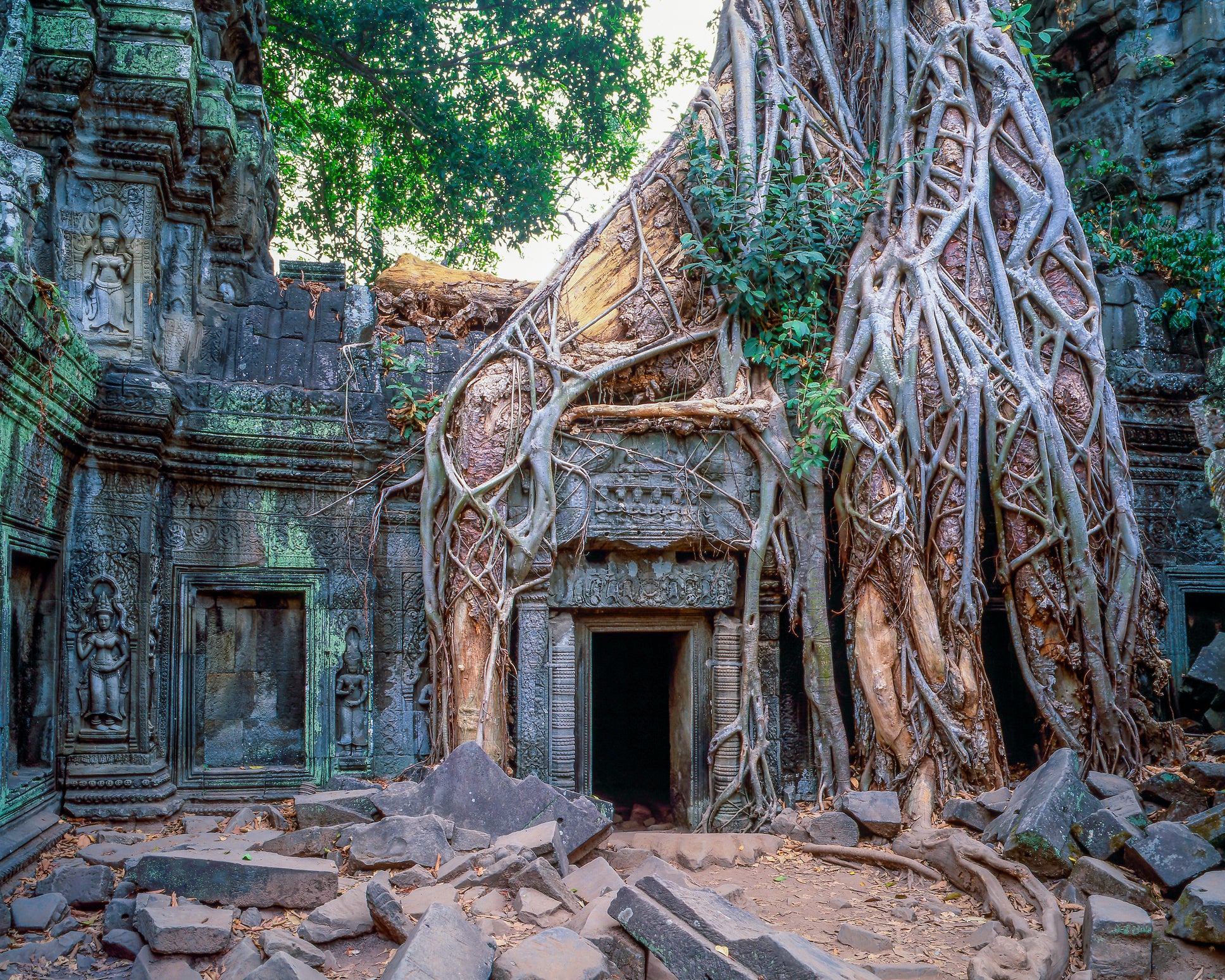
Ta Prohm, the next stop on our temple-crawl, became suddenly popular after its star turn in 2001’s Tomb Raider film. It’s an utterly otherworldly sight, with tumbling chunks of limestone smothered with preternaturally green moss and dripping with tree roots. Nature and architecture collide, the former destroying the latter while also, in some places, seeming to keep it together in a stranglehold of twisted vines and branches. This site deserves more time than a recreation of a Lara Croft photo.
Thanks to extensive landmine clearing, Beng Melea (the name means “lotus pond”) has been accessible to the public for several years now but, requiring a 90 minute drive from Siem Reap, it’s still one of the area’s lesser visited temples. Architectural clues point to it being built under the reign of King Suryavarman II, the same ruler responsible for Angkor Wat.
Read more: This diverse part of Japan is perfect for first-time visitors
Fallen stones are velveted by moss, and trees sprout from ruins. Around everything, butterflies dance crazily in lightshafts. Four lion’s feet remain planted upon a rock; a few feet away, its severed head stares skyward. Nearby, bare-bellied Apsara dancers are frozen, their fingers twisted into impossibly dextrous formations.
As Hun Manet acknowledged, looking towards a future Cambodia requires acknowledging its relatively recent past. The landmine clearing sign at Beng Melea (and the Landmine Museum, complete with sniffer rats) is just one aspect of this. Only around 6 per cent of the population is aged over 65, a direct result of Khmer Rouge atrocities; once you know this, it becomes impossible not to notice how few elderly people you see.
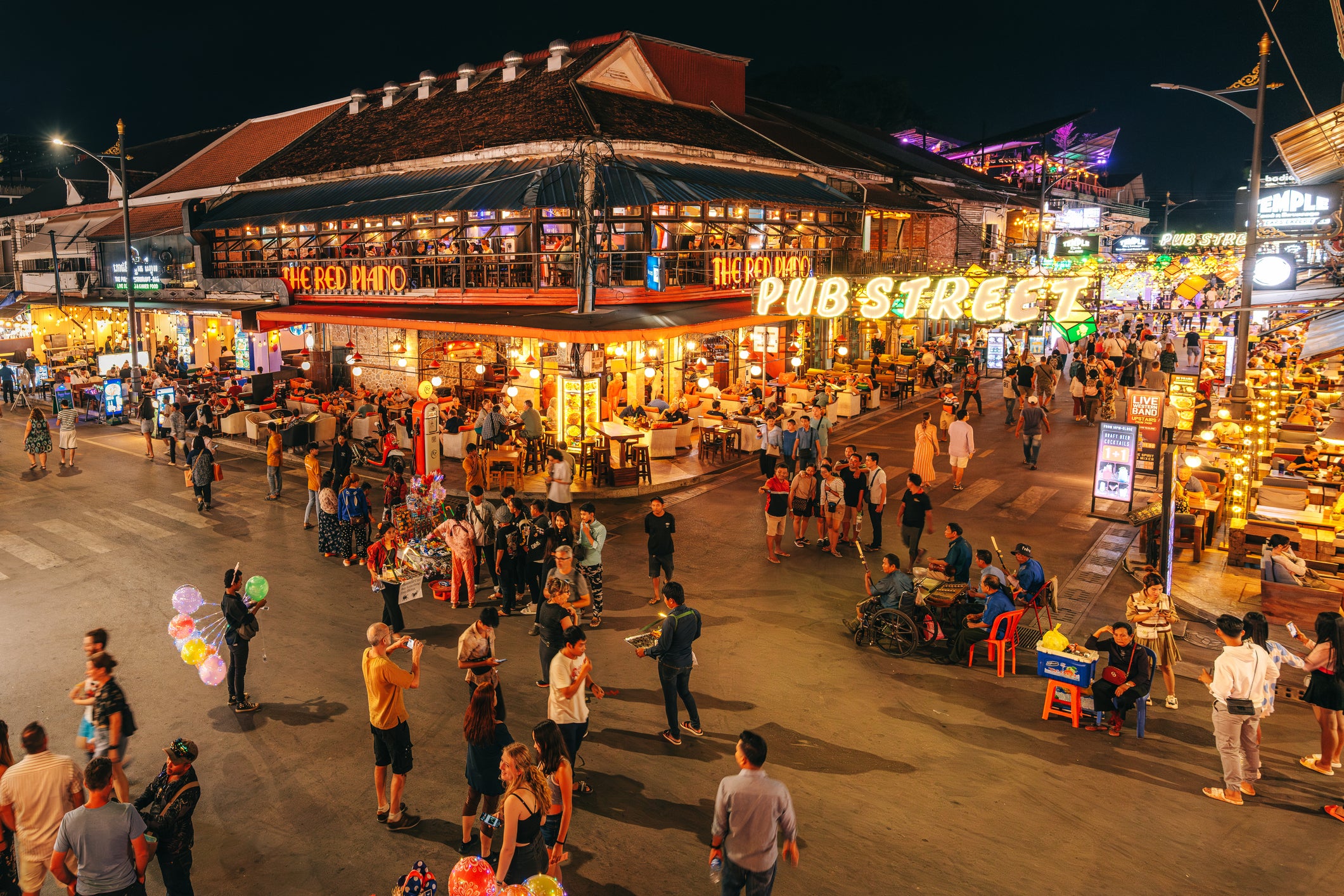
As Cambodia emerged from communism in the early 2000s, it became part of a backpacker trail that included neighbouring Thailand and Vietnam. Raucous Pub Street, with its $1 (74p) beers, $6 (£4.50) massages and designer knock-offs, hark back to this era. But the roads are now paved, not potholed, and vendors, idly scrolling on smartphones, barely glance at you, much less hassle you.
There’s no doubt that this lesser-visited South East Asian country is on the brink of a moment. Although travel from the UK still requires a connection, it’s not inconceivable that the new airports might encourage carriers to establish direct routes – something that would make the destination even more appealing to British travellers.
For the moment, however, Cambodia seems to project its welcoming attitude from a place between two worlds, which makes now the ideal time to visit, before development and investment erode its hopefulness. If there has ever been a time to visit, it’s now.
How to do it
Thai Airways has flights from London Heathrow to Siem Reap Angkor with one stop in Bangkok. Flight time is from 14 hours and prices start at £1276 return.
Where to stay
Pool Access Rooms at FCC Angkor by Avani cost from £178 per night including breakfast. The hotel is centrally located near Siem Riep’s Royal Residence and night market, and offers excursions to the temples, as well as local entertainment.
Sarah was the guest of Avani Hotels